

From Hardware to Hard Cash: Financing the Future of AgTech
- Raymond King

- Mar 10, 2025
- 5 min read
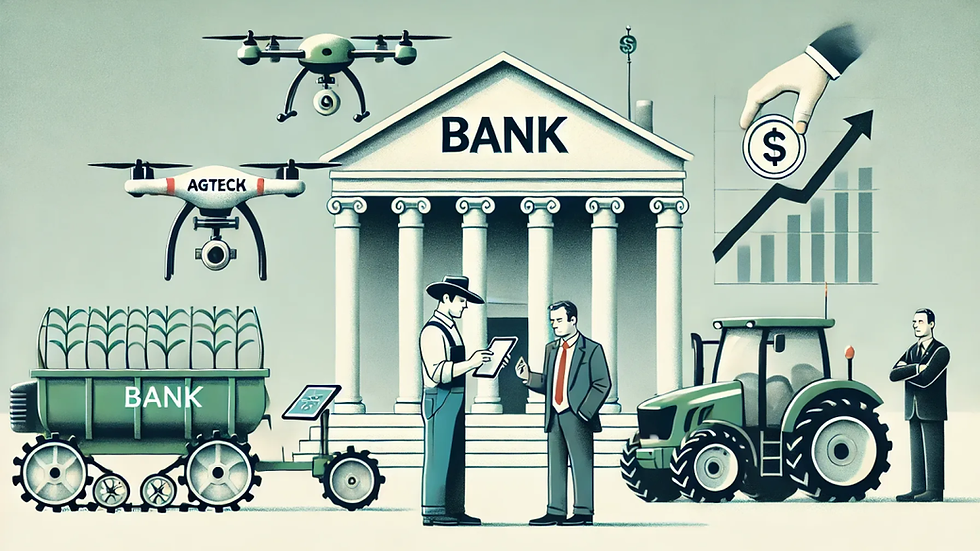
Are new Agtech products being held back from the market by a lack of financing opportunities? Are start-ups and innovators aligning themselves with financiers and credit providers at the right time? What part can credit and financing companies play in promoting AgTech?
So, you are a new hotshot Agtech hardware start-up, you have worked long and hard to get your new technology working, you have worked closely with farmers, growers and other customers to ensure you have good product-market-fit, you have nailed all of the regulatory requirements and you have made great headway on your manufacturing processes. You even have a retail cost for your new product, it’s quite expensive but you have a well oiled “payback" model created to show how farmers will see a return on investment in a few years. You are in the perfect position to launch your product…or are you?
Many innovators miss a vital final piece of the puzzle...financing. How does your customer pay for your amazing new product?
This is where start-ups (hardware start-ups particularly) can falter or even die!
One option is to create a service model, rather than an outright sale to the customer you amortise the cost to them over a number of years. This has been very popular in recent years with the rise of "Software as a Service" (SaaS) and the massive rise in popularity of SaaS products. For a start-up with a new product this solves the problem of farmer affordability. They can easily afford the monthly cost, but as a hardware manufacturer, you are left shouldering the cost of each machine you build and sell. Worse still you don’t realise a profit for years and even when you do reach breakeven the profit trickles in over each month. Cash flow will be very poor and each new machine will require financing somehow either through debt or through selling equity in the company (which can be more expensive in the long run).
So, unless you have very deep pockets or very generous investors, willing to wait a long time for a return, what do you do?
You could always explore the franchise route and set out terms for prospective franchisees that state that part of the “buy in” to the franchise requires buying a number of machines outright, this could work but it still doesn’t solve the problem of how customers raise the cash to buy your products? And the profit is still likely to dribble in via licensing payments or profit sharing agreements.
So what about asset finance? Surely farmers can borrow against the new piece of hardware or machinery? Well, yes and no, farmers are accustomed to financing new machinery in this way but it can be more than a little bit tricky for new products on the market. A tractor, for example, is well understood as a technology and has a known second-hand market and value along with predictable depreciation for age and hours of use. Most tractors will also be manufactured by very large companies that have a track record of product support along with dealership networks for repairs and maintenance. As an Agtech hardware start-up you are going to struggle with all of these points, your product has an unknown second hand market let alone second hand value and so the depreciation is a complete unknown as well. So asset financing is going to be tricky.
What about other assets that the farmer has, often farmers have land or property so could they borrow against this to free up the cash to buy your product. Well a simple answer is yes they could. However, farmers may have other debts raised against these assets already so this could be an option. Also are they willing to literally “bet the farm” on your product?
There are other forms of unsecured financing such as overdrafts or credit cards or loans but these could be expensive or capped.
You could also approach existing machinery dealerships and ask them to carry your product. They have got good distribution channels and they have cash right? Well, dealers will typically want to see a track record of sales before they commit the resources to carrying your product. They also don’t want to hold much stock because stock costs money and they would rather they didn’t tie up capital in machinery that is going to sit in their yard or on their shelf. Dealers will also, ultimately, want to be able to sell hardware to farmers so they will want to know that they can sign up farmers to asset finance deals. Which is the same challenge you are facing.
With all of these factors going against you it may seem that there is no chance of ever selling new pieces of agtech hardware to farmers. So what can you do to help get your hardware on to farms and cash into your account?
Work closely with potential financing partners - Farmers are used to borrowing money to fund investments in infrastructure and new tech. Creating deep personal relationships with the companies and individuals that farmers turn to for financing can help to build trust with farmers and with finance providers.
Financing partners are also product promoters - Lenders often build long term relationships with farmers often have an intimate understanding of the farmers business. This can place them in a unique position to help promote your products to farmers and can be a win - win for lenders and machinery providers.
Think about cost from the outset. - There will be a price point at which there will be enough farmers able to buy your product without having to borrow money. Working with farmers to understand this price and keeping it as a target during engineering and development of your product could mean that farmer adoption doesn’t require loans or financing.
Retrofit- Is there a key part of your product that adds value? Could this part be retrofitted or added to existing products or machinery to help reduce the cost? Ideally to a point where farmers don’t need financing to take a chance on your product? If so this could be a much easier route to market for your product. Or could you partner with a manufacturer to incorporate your product into their machine? Allowing customers to buy your product as part of a larger purchase?
Offer a ‘buy back’ scheme for used equipment - Offering a buy back scheme or offering a good price for used equipment is a good long term strategy for building trust with farmers (and lenders). By buying back equipment you help to show farmers that you have confidence in your product. You also help to stimulate a second hand trade for your product which helps to build market confidence in your machinery and could also help with price discovery for depreciation calculations.
Conclusion: Bridging the gap between innovation and financing
The success of Agtech companies hinges not only on the core technology of a product but also solving the financing challenge. High upfront costs, resale value concerns and a lack of financing options can slow adoption of any new product. Integrating financing strategies from the outset, allows start-ups and innovators to position themselves for scalable success from the beginning.
Flynt Technology Ltd helps AgTech innovators navigate this landscape. As a consultancy specialising in Agtech, R&D, commercialisation and product development, Flynt can bridge the gap between R&D and market adoption.
How Flynt Supports AgTech Startups:
Technology & R&D Consulting – Ensuring products align with market needs and cost structures.
Business Model & Financing Strategy – Structuring products around sales, leasing, and finance partnerships.
Market Adoption Acceleration – Lowering barriers through retrofitting, modular design, and second-hand market strategies.
By aligning product development with financing solutions, Flynt Technology Ltd helps AgTech startups scale efficiently and profitably.


